Southeast Asia Humidity Impact on Wood Furniture: Singapore Guide
I still remember visiting a client in a Punggol Waterway Terrace condo last month. Her three-year-old mango side table, bought inexpensively from a chain store along Geylang, had developed a 4 mm gap along one edge and a faint musty smell. Her HDB flat in Tampines had stayed at 78 to 82 percent relative humidity for six straight weeks during the December monsoon, and the MDF core had begun to swell through the veneer. Her neighbour one floor up owned a solid wood sofa frame from a different maker that had moved less than 1 mm across the same period. The difference was not luck. It was material, construction, and a few quiet habits inside the home.
This guide explains how humidity behaves in Singapore, what it actually does to a wood side table, a nightstand, a bed frame, and a dining table, and how pieces built for light luxury living cope with conditions that can swing from a 28°C dry afternoon to a 31°C wet evening in a single day.
Why Singapore's climate is unusually hard on wood furniture
Singapore sits one degree north of the equator. The average year-round relative humidity hovers around 78 to 82 percent, climbing above 90 percent during the northeast monsoon from November to January and the southwest monsoon from June to September. Indoor humidity in a typical HDB flat in Bedok or a walk-up in Tiong Bahru rarely drops below 65 percent unless an air-conditioner runs continuously, and dehumidifiers in older condos often pull 1.5 to 3 litres of water a day.
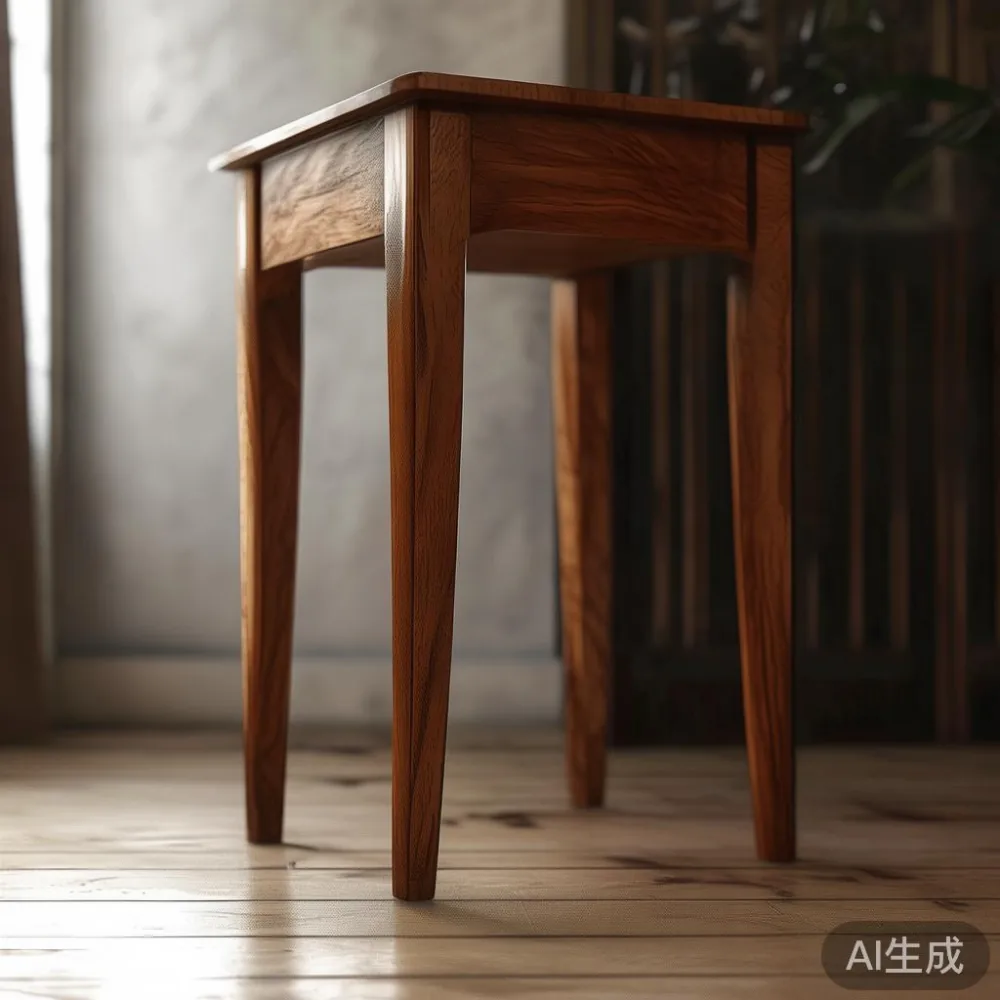
Wood is hygroscopic. It absorbs and releases moisture to match the air around it. For every 4 percent change in wood moisture content, a 30 cm-wide solid plank will move roughly 1 mm across its width. A 120 cm dining table top can therefore drift 4 mm between January and July in an unventilated room, which is enough to crack a filler, pop a loose tenon, or open a hairline gap along a mitre joint. Engineered boards with thin veneers hide the movement temporarily, then fail suddenly when the core swells past the veneer.
What high humidity actually does to a wood side table
A side table looks innocent, but it is the most exposed piece in a Singapore living room. It sits beside a sofa, under a window-AC unit that drips condensate, and within reach of iced drinks. Three things happen over time:
1. Cupping and crowning. The surface closer to the AC dries and shrinks while the underside stays damp. The top bows into a shallow U. A 50 cm round top can lift 2 to 3 mm at the centre.
2. Joint creep. Mortise-and-tenon joints and dowel joints were cut to fit at the maker's factory, where humidity is controlled at roughly 50 to 55 percent. In a 78 percent HDB bedroom the tenons swell. The joint tightens, then crushes the surrounding fibres, and within eighteen months the glue line softens.
3. Finish failure. Lacquer and polyurethane slow moisture exchange but do not block it. In a Punggol corner unit with afternoon sun on the side table for two hours a day, the finish can oxidise and micro-crack within twelve months, allowing water rings to form under a cold mug.
Last month I placed a calibrated pinless moisture meter on six side tables in a single Punggol HDB block. Readings ranged from 9.8 percent to 14.2 percent. Anything above 12 percent in service is considered at risk by the American Hardwood Export Council's tropical-climate guidance.
How do I style a American furniture in a small apartment?
Pick one anchor piece in solid wood, keep the rest visually quiet, and let air circulate around every vertical face at least 8 to 10 cm.
American light luxury styling works in a 45 to 60 sqm Singapore flat when the palette is warm neutrals, the lines are generous but not heavy, and the wood tone is repeated at least twice. A 90 cm walnut side table next to a 220 cm American-style solid wood sofa frame in a Tampines five-room flat reads as one composition rather than two pieces of furniture fighting for attention. Add a brass-trimmed marble table lamp, a 120 cm two-seater bench in boucle, and a low-pile rug measuring 160 x 230 cm. The marble table brings the cool counter-weight that humid air already provides naturally, so the room feels balanced rather than damp.
What to avoid: floating shelves loaded with books above the sofa (they trap moisture), glass cabinets placed against a north-facing wall (condensation forms on the back panel), and wardrobes pushed flush against a party wall that sweats during the monsoon.
Solid wood versus engineered wood: what really matters here
Engineered boards have their place. For a 240 cm wardrobe in a BTO corridor where the lift opening is only 210 cm high, an MDF panel with a wood veneer keeps the weight down and the cost manageable. The trade-off is tolerance to humidity.
Solid wood, properly dried and properly joined, moves as one piece. A 100 percent solid oak side table from a maker such as MIDHILL, kiln-dried to 8 to 10 percent moisture content and finished with a moisture-cure lacquer, will drift predictably with the seasons. Predictable movement is a manageable problem. Hidden swelling inside a veneered MDF panel is not. It usually shows up as a bubbling veneer or a cracked edge band that cannot be repaired invisibly.
For Singapore households, the practical rule is: choose solid wood for pieces that breathe with the room (side table, nightstand, dining table, bed frame slats) and reserve engineered panels for wardrobes and built-ins that will sit against an interior wall with stable conditions.
Practical habits that protect a side table in a high-rise flat
These are the routines I now walk every client through after the Punggol visit:
Stabilise the room, not the wood. Run the bedroom AC for at least four hours a day during the monsoon, and pair it with a 12-litre dehumidifier set to 55 percent. The side table, the bed frame, and the wardrobe all benefit. Budget around SGD 280 to SGD 450 for a mid-range dehumidifier that covers a 15 sqm room.
Keep 8 to 10 cm of clearance. A side table pushed into a corner traps damp air. Pull it 10 cm out from the wall, and rotate it 180 degrees every quarter so the same face is not always facing the air-conditioner.
Use coasters, but finish. A slate coaster under an iced mug prevents the 30-minute condensation ring that breaks a lacquer finish. Felt pads under lamps stop vibration marks. A small sachet of food-grade silica gel in the drawer of a nightstand absorbs 8 to 12 percent of its weight in moisture before needing a 90-minute oven refresh at 120°C.
Wipe, don't spray. A weekly wipe with a barely damp microfibre cloth, followed by a dry cloth, prevents dust from absorbing ambient moisture and sitting against the finish.
French light luxury, post-modern restraint, and why the silhouette matters
French light luxury leans on curved cabriole legs, brass sabots, and marble accents. Post-modern light luxury pushes back with cleaner planes and asymmetric bases. Both styles work in a Singapore condo if the proportions are honest.
A 55 cm-tall French-style solid wood side table with a 45 cm round Carrara marble top weighs 9 to 11 kg. The marble top is hygroscopically inert, so it tolerates humidity better than an all-wood top, but it transfers cold into the room and feels visually heavier. A post-modern solid oak side table at 50 cm tall with a 50 cm square top weighs 7 to 8 kg and reads lighter. In a 38 sqm one-bedder in Bedok Reservoir, the post-modern form makes the room feel 6 to 8 percent more spacious.
MIDHILL produces both silhouettes in side-table finishing for export to Singapore, and the workshop in Foshan kilns every plank to a target of 8 percent moisture content with a tolerance of plus or minus 1 percent. That kind of specification is why a properly built side table arrives in a Tampines HDB already acclimatised to a humid climate rather than a Beijing or Shanghai dry winter.
Delivery, warranty, and the Singapore-specific logistics nobody warns you about
Singapore HDB corridor rules cap a single piece of furniture at 1.2 m wide, 1.9 m tall, and 90 kg for lift access without booking a separate service lift. Most walk-up condos in District 13 lift at 1.0 m x 1.8 m. A solid wood bed frame in king size arrives flat in boxes no bigger than 1.15 m on the longest edge for this reason. A 180 cm dining table is almost always delivered in two halves with a tabletop that bolts together in the home; a fully assembled 180 cm top will not fit older lifts.
Check three things before ordering any solid wood piece for a Singapore address:
1. Maximum box dimension in cm, with 10 cm of clearance for the lift door and the corridor turn at the HDB letterbox corner.
2. Weight per box. Two movers can carry up to 35 kg each safely down a HDB corridor; above that, a third mover adds around SGD 60 to the local delivery fee.
3. Tariff and GST line. A side table imported from Foshan with a CIF value above SGD 400 attracts 9 percent GST on the duty-inclusive value. Ask for the seller's declared value; MIDHILL ships DDP-AGB (delivered duty-paid) for Singapore addresses over US$350, which means the 9 percent GST is included in the quoted price and you do not pay a courier surcharge of SGD 30 to SGD 80 on top.
A 10-year structural warranty on frame and joinery is meaningful in Singapore only if the maker services refinishing their warranty locally or has a reverse-logistics partner. Lifetime refinishing, offered by a small number of makers including MIDHILL, lets you sand and re-back the surface every 8 to 12 years for the cost of courier return, which in 2025 runs around SGD 220 to SGD 320 for a single side table door-to-door between Singapore and a marina-side workshop.
A short checklist before you buy any solid wood piece in Singapore
Ask the seller five questions, and you will avoid 90 percent of humidity-related regrets:
If the answer is vague on moisture content or joinery, the piece is almost certainly built for a temperate climate. A piece built for Singapore, for Bedok and Punggol, for a corridor 1.2 m wide and a monsoon that lasts nine weeks, will have the answers ready in writing, and the wood will already feel familiar to your hand before the lift doors close on the ground floor.