Before You Buy a Sofa You Cannot Sit On: A Practical Singapore Buying Guide
I spend most of my working life around side tables at MIDHILL — measuring drawer depths, checking ash grain on a sample cart, watching two-person delivery crews wrestle a 1.2 m console through a Tampines HDB corridor. So when a client in Punggol emailed me last month asking whether she should "just order the sofa first and figure out the side tables later," I nearly dropped my tape measure. A sofa, after all, is the largest single piece of furniture in most living rooms — roughly 2 m wide, 95 cm deep, often 85 cm tall, and weighing between 65 kg and 110 kg depending on frame. You will live with it for eight to fifteen years. You cannot sit on it before it arrives (showroom stock rarely matches the exact fabric run you ordered). And in a Singapore HDB, you cannot return it just because it crowds your side table. This guide is everything I tell friends, family, and trade clients to verify on paper before they commit.
1. Measure the Lift, the Corridor, and the Door — in That Order
Singapore HDB corridor widths are typically 1.2 m to 1.5 m, lift openings about 0.9 m wide by 2.1 m tall, and main door frames around 0.9 m by 2.0 m. A standard three-seater sofa with a solid wood frame measures roughly 210 cm × 95 cm × 85 cm and arrives in a carton of about 220 cm × 100 cm × 90 cm. Add 10 cm clearance for turning corners, and you have a logistics puzzle. Last month I visited a client in Bedok Reservoir whose previous sofa purchase got stuck on the fifth-floor stairwell — the lift simply would not accept the 2.25 m diagonal. The replacement cost her S$180 in disposal and S$1,400 in a smaller sofa she did not really want.
Do three measurements before you buy:
- Lift car interior (width × depth × height) — your block's managing agent can confirm this.
- Corridor turning radius at each landing.
- Your own front door, including the architrave thickness.
If any single dimension is below 80 cm wide, refuse any sofa carton taller than 200 cm. This single check eliminates about 70% of access-related regret in HDBs.
2. Inspect the Solid Wood Sofa Frame — Not the Cushion
Cushions can be replaced for S$200 to S$600 a set. Frames cannot. Ask the seller to specify the frame species in writing. Acceptable choices for a solid wood sofa include ash, oak, beech, and rubberwood. Anything labelled "engineered wood + solid wood" or "solid wood veneer" means the load-bearing rails are plywood or MDF — perfectly fine for a side table, risky for a sofa you cannot test for ten years. Ask for a cross-section photo of the rail joinery: mortise-and-tenon or dowelled corner blocks beat staples every time. Confirm kiln-dried to 8–12% moisture content (Singapore's ambient is around 80% RH, so green timber will move).
At MIDHILL we kiln-dry ash to 10% MC and use a 3 cm × 6 cm load rail on every sofa we ship — the same spec we use on our bed frames and wardrobes. That consistency is what gives us the confidence to offer a 10-year structural warranty. Whatever brand you choose, the question is the same: "What is the load rail dimension, and what is the moisture content?" If the salesperson cannot answer in numbers, walk away.
3. Match the Sofa to the Side Table, the Rug, and the Ceiling Fan
A sofa is a system anchor. Pick it before your dining table, your nightstand, your marble console, and definitely before your side tables. Two rules I use when laying out a 12 m² HDB living room:
- Sofa back height should sit at least 15 cm below the ceiling fan blade sweep — usually 32 cm below a 2.6 m false ceiling.
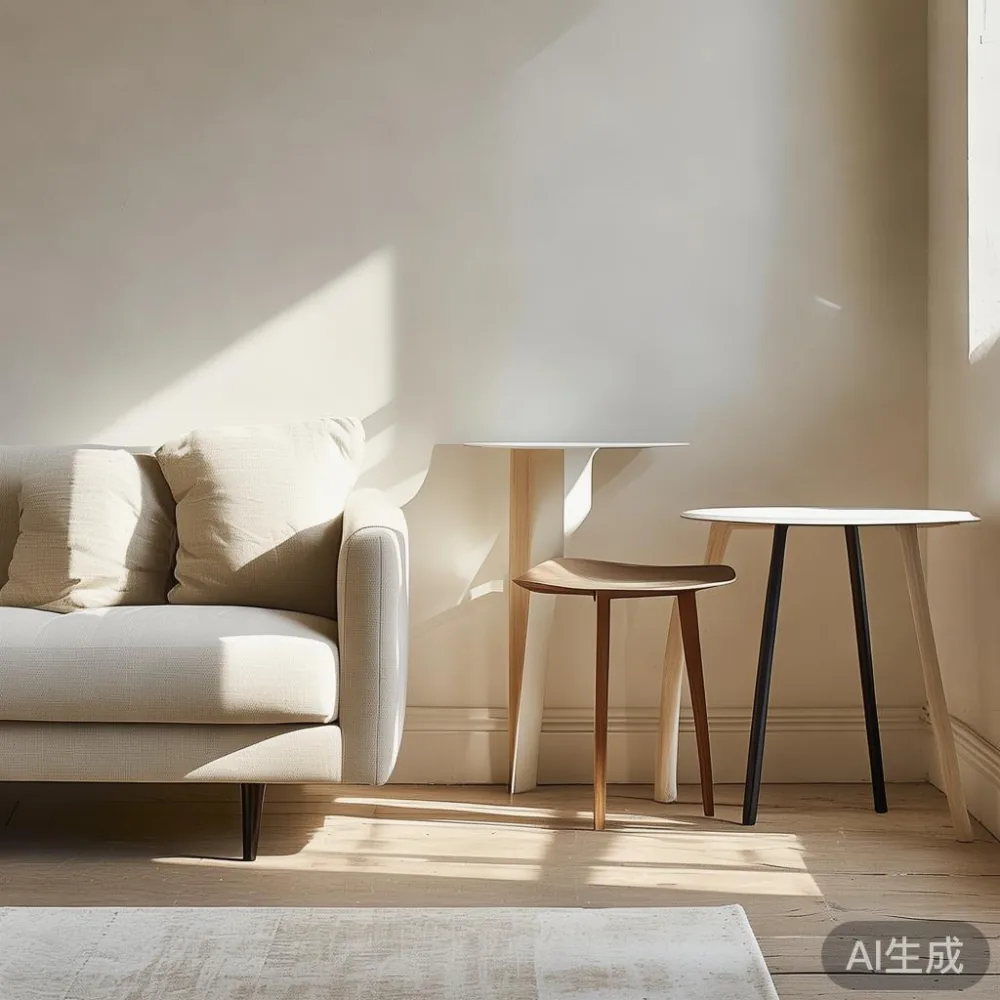
- The side table top should land within 5 cm of the sofa arm height (typically 58–65 cm). A mismatch of 12 cm or more makes putting down a coffee cup feel like a stretch.
If you are aiming for a French light luxury look — soft curves, brushed brass feet, neutral bouclé — a 210 cm sofa with a 55 cm arm pairs well with a 60 cm tall marble table side piece. For an American light luxury feel — deeper seats, rolled arms, walnut tones — push the sofa depth to 105 cm and keep the side table at 50 cm diameter to preserve walking space. Post-modern light luxury, the trend currently moving through Punggol and Bukit Timah showrooms, blends a low 78 cm sofa back with slim 45 cm side tables in smoked glass and blackened ash. In every case, the side table is the supporting actor, not the star. Get the sofa geometry wrong and no side table will save the room.
4. Decoded: Fabric Codes, Foam Grades, and Spring Counts
Most Singapore buyers see "linen-look polyester" or "high-density foam" on a spec sheet and nod politely. Here is what those phrases actually mean, and the questions that pull real answers out of a seller:
- Fabric rub count (Martindale): ask for the number. Below 15,000 rubs is decorative; 30,000+ is contract-grade and the right zone for a family sofa.
- Foam density: 25 kg/m³ feels soft for six months, then sags. 32–35 kg/m³ holds shape for five to seven years. Anything below 22 kg/m³ is a cushion, not a seat.
- Spring system: "sinuous spring" means S-shaped wire, common and acceptable if 8-gauge. "8-way hand-tied" is premium and roughly S$1,800 more. "Webbing only" is fine for occasional chairs, weak for daily sofas.
- Leg material: solid beech or ash is repairable; metal legs that bolt into plywood brackets usually loosen at year three.
A trustworthy seller will have these numbers on a printed spec card. If they wave a hand and say "premium quality," you are paying for the word, not the spec.
5. Read the Warranty Like a Contract Lawyer
Singapore's Consumer Protection (Fair Trading) Act gives you basic rights, but warranty terms vary wildly between brands. Two clauses matter more than any marketing slogan:
- Structural warranty length and what it covers. Ten years on the frame is the benchmark a serious maker should meet. Five years is acceptable. Three years is a yellow flag.
- What happens to shipping if a defect appears. A solid warranty covers both the replacement part AND the logistics — a return trip for a 90 kg sofa in a HDB costs S$120 to S$220 in courier fees alone.
MIDHILL's 10-year structural warranty covers frame, rails, and spring systems, and includes on-site inspection within Singapore for verified defects. Lifetime refinishing is also offered on solid wood surfaces — meaning if your ash frame gets scratched during a Punggol renovation move-in, the workshop will sand and re-oil it for a nominal fee rather than charging you a new sofa. Free shipping kicks in above US$350 (roughly S$480), which most sofa orders clear easily, so the real question is whether the warranty reads like a contract or like a brochure.
6. What About Delivery Timelines, GST, and the 14-Day Window?
Budget for these Singapore-specific line items:
- GST 9%: applied to the full landed price including delivery, effective from 1 January 2024. A S$3,200 sofa becomes S$3,488 before tip.
- Delivery window: made-to-order solid wood sofas ship in 30–45 days from a Foshan workshop, plus 7–10 days sea freight to Singapore, plus 3–5 days for customs and last-mile. Plan for 6–8 weeks total if the item is in production.
- 14-day return policy: only meaningful if the sofa arrives in original packaging and you have kept the plastic wrap intact. Once the legs are bolted on, most brands — including ours — treat the unit as used. Photograph the unboxing.
- Installation: two-person HDB delivery typically costs S$60 to S$120, depending on lift access and floor.
If a brand promises 7-day delivery on a custom solid wood sofa, they are shipping from local warehouse stock, which limits fabric and configuration choices. Decide which trade-off matters more to you.
7. How Can a Side-Table Specialist Judge a Sofa Brand in 10 Minutes?
My colleagues and I get asked this constantly at the MIDHILL showroom. We use a five-point checklist that anyone can run in a retail outlet:
- Lift one corner of the sofa. A solid wood frame on proper springs should feel heavy at the back, lighter at the front. If the whole unit lifts like a feather, the frame is hollow.
- Look underneath. The fabric dust cover should be stapled, not glued. Glued covers hide bad frames.
- Sit on the arm. Solid wood arms do not compress. Plywood arms creak within ten seconds.
- Ask for the foam density written on the spec sheet. If the salesperson writes "high resilience" instead of "32 kg/m³," move on.
- Check the matching side table in the showroom. A maker that gets a 45 cm ash nightstand right usually gets the sofa right. A maker whose side tables wobble will not save you on the larger piece.
That last point is the trick I share most often: a sofa brand is judged by its smallest piece. If the side tables are sloppy, the sofa frame is sloppy. If the side tables are tight, square, and finished on every face, the brand has discipline.
8. What is the difference between Japandi headboard and modern furniture?
The Japandi headboard is a low, often floor-to-ceiling panel in pale ash or oak that anchors a bed frame the way a shoji screen anchors a wall — quiet, structural, and intentionally minimal — whereas modern furniture refers to the broader 20th-century movement of geometric forms, mixed materials (steel, glass, plywood), and functional silhouettes that emerged after the 1920s and still dominates most Singapore condo showrooms today.
In practical terms for Singapore buyers: a Japandi headboard is a specific design object, typically 90–110 cm tall and 160–200 cm wide for a queen bed frame, made from solid ash or oak with a 6–8 cm thickness and a visible end-grain detail. Modern furniture is a category, not a piece — it includes everything from a Marcel Breuer chair to a flat-pack Swedish side table. The Japandi approach blends Japanese negative space with Scandinavian hygge, producing a headboard that doubles as a quiet backdrop; the modern approach treats the headboard as one component among many, often pairing it with a slim metal frame or a marble table on either side. If you are buying a bed frame for a 12 m² HDB bedroom and want the room to feel calm, the Japandi headboard is usually the right call. If you are furnishing a 25 m² condo master suite and want visual contrast, a modern low-profile platform with a brass-trimmed side table works harder.
9. Common Singapore Buying Mistakes I See Every Quarter
After fifteen years of measuring HDB rooms and condo living areas, the same five errors repeat:
- Buying the deepest sofa available. 105 cm seats look luxurious but force the side tables out 15 cm from the wall, shrinking the walking lane to 60 cm. Stay at 95 cm unless your room is over 4 m wide.
- Trusting showroom-only stock. The sofa you sit on in the Simei showroom may not be the sofa that ships. Always request a production swatch and a frame photo from the current batch.
- Ignoring ceiling fan sweep. A 1.4 m fan needs at least 75 cm clearance from any sofa back. Measure from the fan centre, not the ceiling.
- Underestimating weight. A 90 kg sofa on a hollow-core HDB floor is fine; the same sofa on a 6-year-old vinyl may compress over time. Use felt pads and rotate the unit annually.
- Skipping the side table sizing step. Buyers obsess over fabric and ignore the 5 cm height rule between sofa arm and table top. This single number decides whether the room feels composed or awkward.
10. A Note on Light-Luxury Styling Without the Price Tag
French light luxury (think curved silhouettes, cream bouclé, brushed brass feet) reads as expensive in showrooms but pairs poorly with small HDB rooms — the curves eat floor space. American light luxury (rolled arms, deeper seats, leather-look performance fabric) holds up better in family homes and matches a walnut dining table cleanly. Post-modern light luxury, the newest of the three, works best in new BTOs at Punggol and Tengah: low backs, slim arms, smoked-oak tones, and side tables in grey ash wood outdoor patio-inspired finishes that bridge indoor and balcony zones. In a 14 m² living room, a post-modern light luxury sofa at 200 cm wide, paired with two 45 cm ash side tables and one 90 cm marble coffee table, will read as composed without crowding.
11. Final Practical Checklist Before You Click "Order"
Print this and keep it next to your phone during checkout:
- Frame species written on the quote (ash, oak, beech, rubberwood).
- Load rail dimensions (3 cm × 6 cm minimum).
- Foam density 32 kg/m³ or higher.
- Fabric Martindale 30,000+ rubs.
- Spring type and gauge in writing.
- Carton dimensions confirmed against your lift, corridor, and door.
- 10-year structural warranty covering frame and springs.
- Delivery timeline 6–8 weeks, with refund clause for delays over 30 days.
- 14-day return policy with original packaging requirement.
- Total landed price including 9% GST and HDB delivery.
- Side table height matched within 5 cm of sofa arm.
Tick all eleven and your sofa will outlast three rental cycles, two renovations, and one toddler. Tick nine and you are still ahead of most Singapore buyers. Tick fewer than seven and the piece will disappoint by year three — not because the brand is dishonest, but because specifications were never aligned. A sofa you cannot sit on before buying demands paper discipline, not showroom romance. Measure twice, specify everything, and keep the side tables in the conversation from the start.