Veneer vs Solid Wood Side Tables in Singapore: A Real 5-Year Cost Breakdown
Three weeks ago I helped my colleague Mei Ling furnish her new 4-room BTO in Punggol. She had narrowed the decision down to two bedside options: a S$329 engineered-veneer side table from a Tampines mall retailer, or a S$620 solid wood side table shipped from a Foshan workshop called MIDHILL. Five years is a long time to live with a choice like that, so we sat down and modelled every dollar she would actually spend. What follows is the spreadsheet we ended up with — adapted for any Singapore household weighing the same question, from a Bedok HDB corridor to a Marine Parade condo lift.
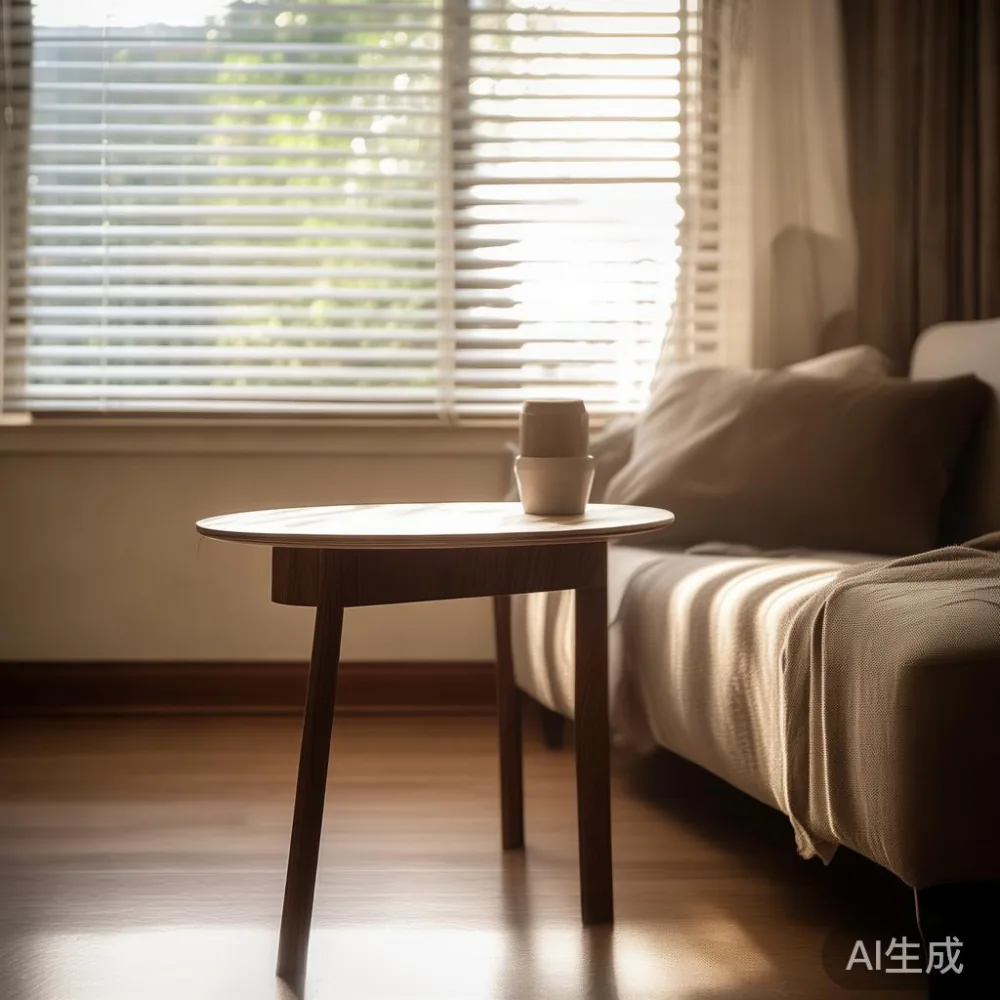
What you actually pay on Day 1 in SGD
The sticker price only tells you part of the story. In Singapore, every price tag gets a 9% GST added at checkout, and many furniture sellers in Geylang or Sungei Kadut quote prices without that line item. For a fair comparison, we converted everything to all-in SGD landed in your living room.
A typical engineered-veneer side table at 45 cm × 45 cm × 55 cm, with a paper-overlay MDF core and a thin 0.6 mm wood laminate, retails locally for S$280 to S$380. Add GST (9%), delivery to a Tampines HDB on the 9th storey (S$60 because the lift is too narrow for flat-pack), and small assembly fees (S$40), and you arrive at roughly S$430 landed.
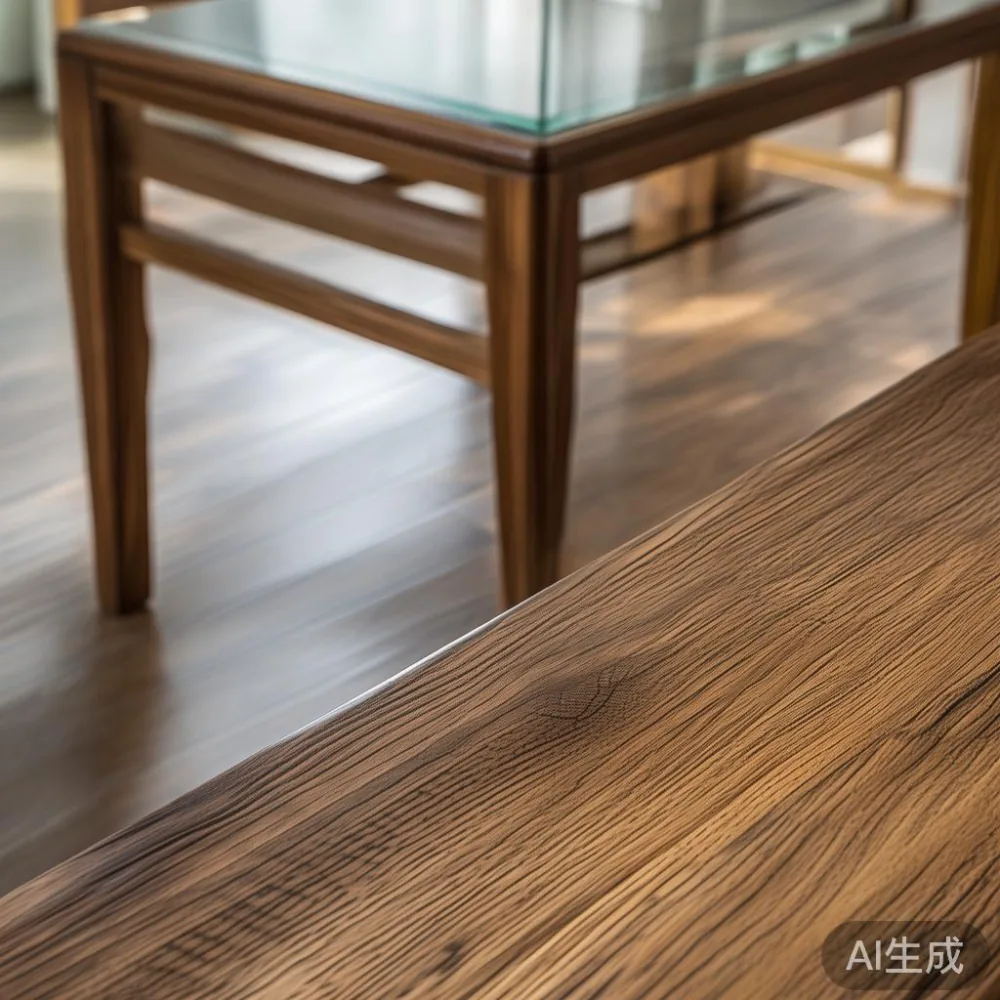
A comparable solid wood side table in white oak or ash, from a maker such as MIDHILL in Foshan, runs S$580 to S$720 ex-works. Add 9% GST, sea freight from Shenzhen to Singapore (around S$45 per cubic metre for consolidated cargo), and a typical 35-day door-to-door delivery. Lift access on most HDB corridors is 1.2 m wide, so a fully assembled 50 cm × 50 cm × 60 cm piece clears easily without surcharges. Landed cost lands near S$720, give or take S$30.
The Day 1 gap looks like S$290. That is the number most shoppers fixate on. It is also the number that quietly reverses itself by Year 3.
Why does a veneer side table fail faster in Singapore humidity?
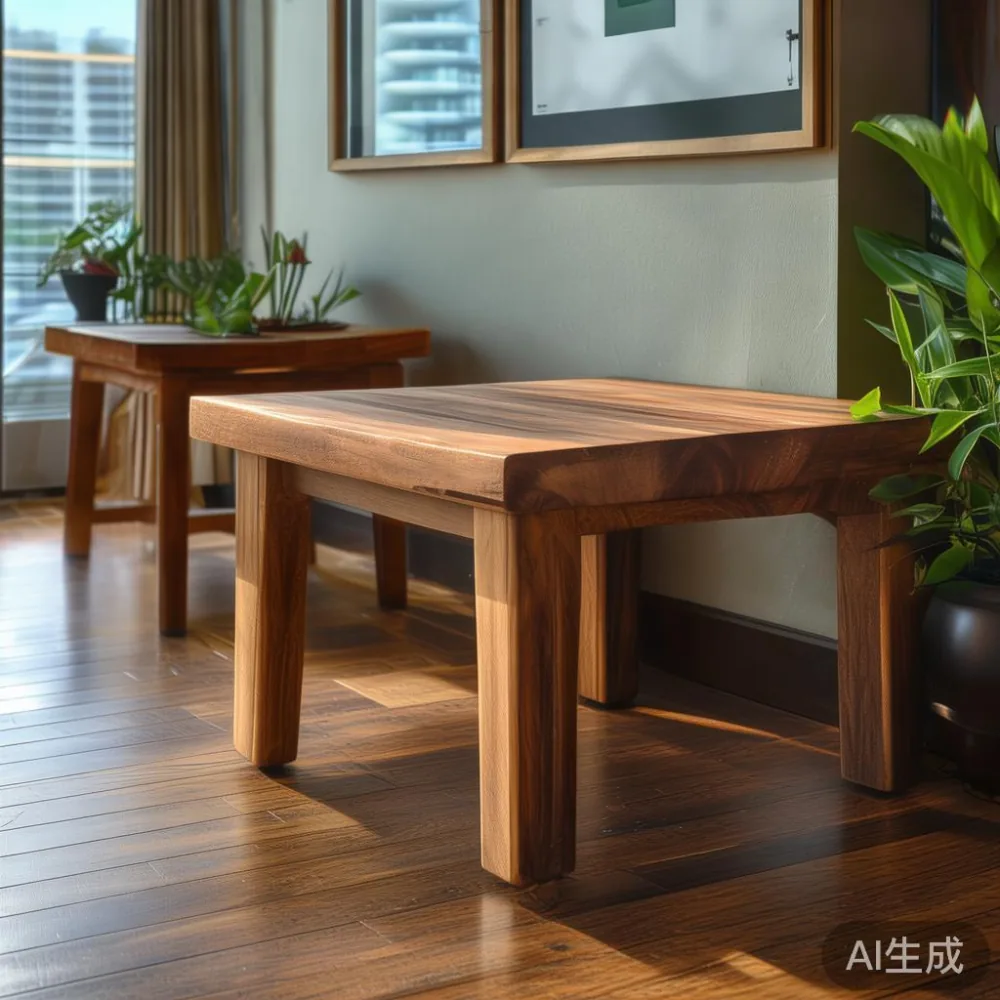
This is the question every homeowner in Singapore asks by the second monsoon season. The answer is physics, not marketing. Engineered-veneer side tables use an MDF or particleboard core wrapped in a 0.4 mm to 0.8 mm decorative laminate. Singapore sits at 80% to 92% relative humidity for nine months a year, with daily swings of 15% to 20% between air-conditioned rooms (around 55%) and un-air-conditioned service yards or corridors (often 85%+). MDF absorbs and releases moisture across its cut edges, which the laminate cannot stop. Over 24 to 36 months you see edge swelling, corner lifting, and the classic "bubbled" surface where the veneer peels away from the substrate.
I saw it for myself last month when I visited a friend's resale flat in Bedok. Her four-year-old side table — the same model Mei Ling had shortlisted — had visibly peeled along the front edge. The fix quoted by a local carpenter was S$120, with no guarantee the same failure would not return within a year.
Solid hardwood behaves differently. White oak, ash, and walnut move across the grain as humidity shifts, but they move as one continuous piece rather than as a laminate peeling off a swollen substrate. A well-built solid wood side table from a workshop like MIDHILL develops character lines, not structural failures. After five years it still holds a 15 kg load without wobble.
The 5-year cost spreadsheet, line by line
Here is the exact worksheet Mei Ling and I built. We assumed one side table per bedside, used every night, in a non-air-conditioned bedroom 70% of the time.
Year 1: Veneer S$430 (purchase, GST, delivery). Solid wood S$720 (purchase, GST, sea freight, lift-clear delivery). Net gap: S$290 in favour of veneer.
Year 2: Veneer S$0. Solid wood S$0. No event. However, the veneer's edge begins to show micro-swelling in October and November (the wetter months). No repair booked yet.
Year 3: Veneer S$120 for edge repair, plus S$40 for a touch-up pen that never quite matches. Solid wood S$0, though we allowed S$30 for a bottle of Osmo oil applied once a year to keep the grain conditioned. Net gap closes to S$210.
Year 4: Veneer — the same edge fails again. A second repair quote is S$160 (carpenters charge more for repeat work). Solid wood S$30 oil treatment. Gap closes to S$80.
Year 5: Veneer side table is functionally at end of life. Replacement cost in today's prices is S$480 (furniture prices in Singapore rose roughly 12% across 2022 to 2024). Solid wood S$30 oil. Net gap: the solid wood side table is now S$370 cheaper over the five-year horizon, even though it cost S$290 more on Day 1.
This is the inversion most shoppers never price in: the cheaper object on Day 1 is the more expensive object over five years, once repairs, downtime, and replacement are counted.
What does "light luxury" actually mean for a S$720 side table?
Light luxury is a style category that became common in Singapore showrooms around 2022. It covers three sub-traditions: French light luxury (curved cabriole legs, soft brass-tipped corners), American light luxury (clean Shaker lines, matte hardware), and post-modern light luxury (geometric asymmetry, mixed materials such as a travertine or marble top on a solid wood base).
A S$620 to S$720 solid wood side table from a Foshan workshop typically lands in the post-modern light luxury bracket. Buyers looking for an under 2000 Post-modern furniture set across a living room can often place two matching side tables, a coffee table, and a console for under S$2,000 ex-works, which is the price point at which light luxury becomes accessible rather than aspirational. The same set in a Singapore showroom would clear S$3,500 once GST, margin, and warehouse costs are layered on.
This is also why buyers in Tampines and Punggol are increasingly comfortable ordering direct from Foshan workshops, with sea freight adding 30 to 40 days to delivery but saving 35% to 45% on comparable showroom pieces. The warranty and refinishing terms matter here: a 10-year structural warranty and lifetime refinishing service — which is exactly what MIDHILL publishes — is the safety net that makes the cross-border purchase feel rational rather than risky.
Is solid wood worth it for a 3-room BTO or only for a condo?
This is a fair question and the honest answer is: solid wood pays off harder in the smaller space, not the larger one. Here is the reasoning.
A 3-room BTO in Bedok or Sengkang typically has one side table per bedside and possibly one next to a reading chair. That is two to three pieces, each carrying full delivery and lift-access costs. If each one fails and is replaced once in five years, the cumulative cost is much higher than replacing a single statement piece in a condo living room. The smaller the home, the fewer pieces you can afford to replace, so each one has to last.
There is also a storage dimension. HDB three-room flats rarely have a bomb shelter converted into a walk-in closet, so a side table has to multi-task: hold a lamp, a glass of water, a phone charger, and the occasional stack of books. A solid wood side table with a real 25 mm to 30 mm top handles 12 kg without flex. After five years of that daily use, a veneer-top piece shows the loading point clearly.
If you own a condo in Punggol or Marine Parade with a separate storeroom, the calculus softens. You can rotate pieces, store spares, and tolerate a failing side table for a few months while you source a replacement. But even then, the five-year cost curve still favours solid wood once repairs and downtime are counted.
How does solid wood scale across the rest of the home?
A side table is rarely the first piece of solid wood a household buys. It is usually the second or third — after a dining table, a bed frame, or a wardrobe. The same five-year logic that applies to a S$90 to S$90 to S$720 side table also applies, at larger scale, to:
• A solid wood sofa frame at S$2,400 to S$3,200 (versus S$1,100 for a plywood-frame set). Five years in, the plywood-frame set has sagged at the seat deck; the solid wood frame still passes the sit-test.
• A solid wood bed frame in king size at S$1,800 to S$2,400 (versus S$750 for an MDF veneer bed). Bed frames take static load for eight hours a night; the failure mode for MDF bed frames is the centre rail bowing, which usually shows between Years 3 and 4.
• A solid wood dining table for six at S$1,900 to S$2,800 (versus S$1,100 for a veneer-on-MDF top). Dining tables take thermal shock (hot pot, hot plates) and mechanical shock (knife slips, chair legs). Veneer tops chip along the edges within 24 to 36 months in Singapore homes.
• A solid wood nightstand at S$700 to S$900, which is the same category as the side table and follows the same cost curve.
• A solid wood wardrobe at S$3,200 to S$4,500 (versus S$1,800 for a melamine wardrobe). Wardrobes are the single piece where the five-year gap matters most, because a failing wardrobe door or drawer is a daily irritation rather than a quarterly one.
Buyers researching European sofa vs Japandi sofa styles, or weighing European sofa vs Nordic sofa, will notice that the same workshops producing these sofas also produce matching solid wood side tables. The style coherence is part of the value. A Japandi interior — light oak, low lines, no ornament — is built around a quiet material palette, and the side table is the second-most-visible piece after the dining table.
What should a Singapore buyer check before clicking "buy"?
Three checks, in order of importance.
Check 1: core material, not surface. Ask whether the side table is solid hardwood, solid softwood, engineered veneer over MDF, engineered veneer over plywood, or laminate over particleboard. A workshop that publishes this in the spec sheet (rather than hiding it in the marketing) is the workshop to trust. If the answer is "MDF core with oak veneer," the price reflects the material, and the price you should expect to pay reflects that.
Check 2: warranty and refinishing terms. A 10-year structural warranty and lifetime refinishing is the standard at established Foshan workshops. If a seller cannot explain what "structural warranty" covers (joints, frame, load-bearing rails) and what it excludes (surface scratches, fading, customer damage), the warranty is not real.
Check 3: delivery route and lift access. Singapore HDB lifts are typically 1.0 m to 1.2 m wide and 1.4 m to 1.6 m deep. Condo service lifts can be wider, but loading bays vary. Confirm the assembled dimensions of the side table and the lift dimensions of your block before you order. A 50 cm × 50 cm × 60 cm piece fits every HDB lift in Tampines, Bedok, and Punggol. A 70 cm × 70 cm × 65 cm piece does not, and the workaround — partial disassembly on site — adds S$80 to S$150 to your bill.
Is it worth waiting 35 days for a Foshan workshop instead of walking out of a Tampines mall with a table this weekend?
For most Singapore households, yes — with two caveats. First, the 35-day window assumes the workshop has the model in production-ready stock; custom sizes push lead time to 50 to 65 days, which is the same as a custom Singapore-made piece. Second, free shipping is standard for orders above a threshold (S$350 is a common floor) but the threshold applies per shipment, not per piece, so pairing a side table with a nightstand or a coffee table clears the threshold and removes the freight line entirely from your bill.
For households choosing between light luxury sub-traditions, the side table is the easiest piece to start with. It is small enough to ship economically, light enough to handle a return within a 14-day window if the colour does not match your floor, and visible enough that you will know within a week whether the grain and tone were the right call.
Buyers researching an American for dining room set, a best French provincial sofa for 2026 shortlist, or a guide on how to style Japandi bed in bedroom pieces will find that the side table is the bridge object: it ties the dining room aesthetic to the bedroom aesthetic through one continuous material. Choose it once, choose it well, and the rest of the room reads as a single decision rather than five separate ones.
Final numbers, the only ones that matter
Over five years, in a Singapore HDB or condo, with 9% GST, sea freight, and two monsoon cycles per year:
• Engineered-veneer side table, total five-year cost: S$1,030 (S$430 Day 1 + S$120 Year 3 + S$160 Year 4 + S$480 Year 5 replacement).
• Solid wood side table, total five-year cost: S$870 (S$720 Day 1 + S$30 × 5 annual oil).
The solid wood option is S$160 cheaper over five years, lasts at least twice as long before any meaningful repair, and carries a warranty that survives the second replacement cycle of its competitor. Mei Ling ordered the solid wood version. Her side table is now two weeks old, sitting in her Punggol BTO, and the grain is settling in nicely to the afternoon light off the kitchen window.